ISIS@MACH: A new partnership between ISIS and the Lazio, Italy
ISIS@MACH— the new MAterials Characterisation Hub in Lazio, Italy — marks a major partnership between the University of Rome “Tor Vergata”, Regione Lazio, and the ISIS Neutron and Muon Source in Oxfordshire, UK. Funded by Regione Lazio under the POR FESR 2014–2020 programme, the project strengthens Italy’s research infrastructure and expands access to world-leading neutron and muon techniques.
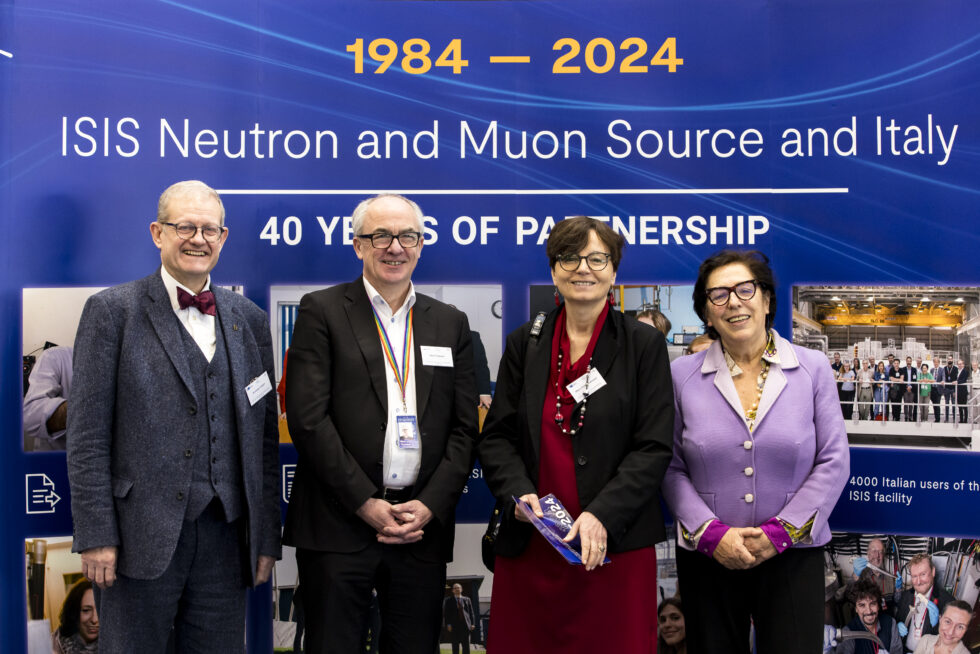
This milestone builds on a collaboration between Italy and the UK dating back to 1985, enabling scientists from both countries to share expertise and advance multidisciplinary research using neutron and muon instruments.
Jill Morris, British Ambassador to Italy, said:
“ISIS@MACH is an excellent example of UK–Italy scientific collaboration. We are proud to have supported its development and look forward to its future impact.”
Daniele Leodori, Vice-President of Regione Lazio, added:
“This flagship partnership showcases our region’s commitment to innovation and international cooperation. The collaboration between Tor Vergata and ISIS has thrived for decades, and we’re confident it will continue to grow.”
Understanding materials at the nanoscale is key to tackling global challenges — from green energy and health care to cultural heritage and aerospace. Through ISIS@MACH, researchers from Tor Vergata, the Centro Fermi, and ISIS will work together across fields such as biomaterials, energy, and advanced engineering.
Prof. Robert McGreevy, Director of ISIS, said:
“We are delighted to celebrate the inauguration of ISIS@MACH. Our partnership has delivered great benefits to both institutions and the wider scientific community.”
Prof. Luisa Cifarelli, President of Centro Fermi, added:
“ISIS@MACH will drive progress in areas from aerospace and health to green technologies and cultural heritage.”
As the first ISIS Hub outside the UK, ISIS@MACH offers coordinated access to facilities in Lazio and at ISIS in Oxfordshire. It brings together experts in nanoscience, synthesis, and neutron and muon analysis, providing researchers with a unified entry point for advanced materials studies.
Prof. Giuseppe Novelli, Rector of Tor Vergata, noted:
“ISIS@MACH is the first research infrastructure based on an Italian university campus. It strengthens our long-standing collaboration with ISIS and offers unique opportunities for students and researchers.”
Prof. Aldo Di Carlo, coordinator of ISIS@MACH, concluded:
“Together with the ISIS team, we aim to make user access to our facilities a cornerstone of Italy’s future research strategy.”
Beyond materials science, the partnership has also advanced research in cultural heritage — from Renaissance sculptures such as the Ghiberti Heads to studies of biological systems and drug delivery mechanisms — demonstrating the versatility and impact of neutron and muon techniques.
For more information, visit
ISIS, STFC or
ISIS@MACH ITALIA.