Science
Joanna Blaszczyk
10 June 2021

Uncovering the Secrets of Ancient Egyptian Leather with Neutrons

Understanding how the original manufacturing process affected preservation of Egyptian leather sandals over millennia
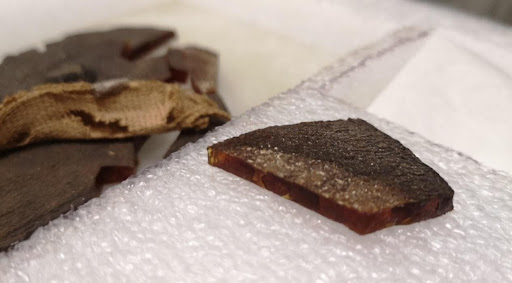

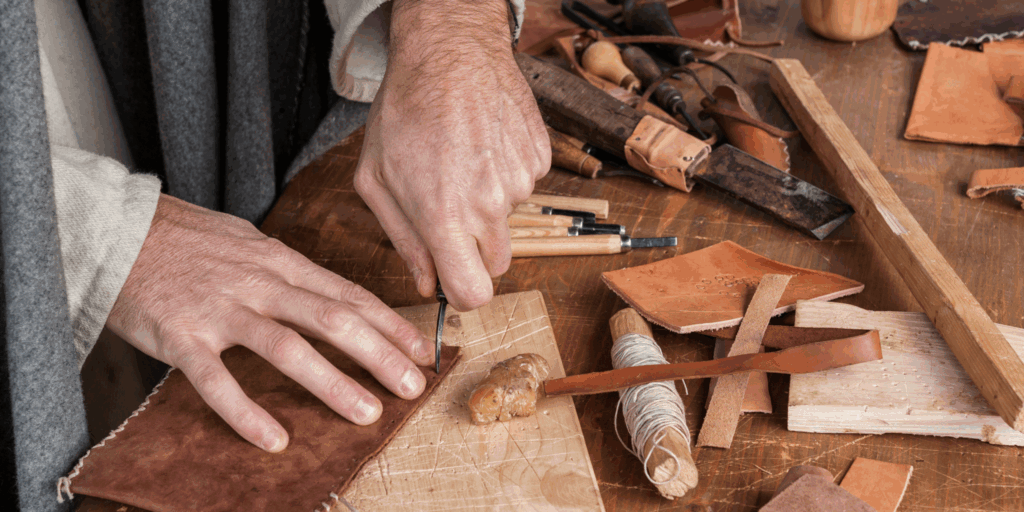
Leather sandals, bags, and furniture fragments from ancient Egypt are among the most remarkable organic artifacts preserved at the Museo Egizio in Turin. Dating back as far as 1400 BCE, these objects once formed part of daily life — and, thousands of years later, they continue to tell us stories about how people lived, worked, and crafted materials.

But leather, being organic, is fragile. Over millennia, it changes chemically and physically, often turning brittle or even gelatinous. Understanding what’s happening inside these ancient materials is vital to protecting them for the future — and that’s where physics meets archaeology.

An international research team from the University of Rome Tor Vergata, Museo Egizio, The American University in Cairo, and ISIS Neutron and Muon Source (UK) worked together to study how ancient Egyptian leather was made and how it has degraded over time.

Using a suite of advanced tools — including X-ray Fluorescence (XRF), Raman spectroscopy, Scanning Electron Microscopy (SEM), and Neutron Scattering techniques — they analysed tiny fragments of sandals and other leather artifacts without damaging them.

What makes this study unique is the use of neutron-based methods at the ISIS facility in the UK. Neutrons can penetrate deep inside an object, revealing information about its internal structure, hydration level, and chemistry — things that surface-based tools can’t easily detect.

The researchers discovered that many of the leather pieces had undergone partial dehydration — meaning that water once locked within the leather’s collagen fibres had been lost over time. This dehydration alters the material’s mechanical strength and is closely linked to the gelatinisation seen in some of the samples.

By comparing results from inelastic and deep inelastic neutron scattering, they could measure how much hydrogen — and therefore water — remained inside the samples. On average, the ancient leather contained about 16% water, confirming significant but not total drying over the centuries.

Chemical analyses provided further insights. XRF and Raman spectroscopy showed the presence of iron oxides, phosphates, potassium alum, and carbonates — all markers of the materials and methods used in ancient tanning.

  • Iron and alum suggest that ancient craftspeople may have used mineral-based tanning agents or dyes.

  • Phosphates and hydroxides could point to oil curing, a technique that softened hides using fats and oils.

  • Carbonates may come from lime or calcium compounds used to prepare the skins.

High-resolution SEM imaging revealed the microscopic structure of the leather: cracked surfaces, separated collagen fibres, and crystalline deposits — all signs of dehydration and mineral residues. Energy-dispersive X-ray spectroscopy (EDX) also identified salts like sodium chloride and calcium sulfate, likely formed during burial or early conservation treatments.

This research demonstrates how neutron science can support cultural heritage preservation. While laboratory techniques such as XRF and Raman spectroscopy reveal surface details, neutrons probe deep into the bulk of the material, uncovering internal composition and hydration — without causing damage.

“Neutron-based experiments give us enhanced information that complements traditional analyses,” explains Professor Enrico Preziosi of the University of Rome Tor Vergata. “They help us understand not just what’s on the surface, but what’s happening inside — where the story of degradation and preservation truly lies.”

By combining physics, chemistry, and archaeology, the team has provided new insight into how ancient Egyptian leathers were made and how best to preserve them today.

Their results, published in Information (Romanelli et al., 2022), show that cutting-edge physics facilities like ISIS and ISIS@MACH ITALIA can play a key role in understanding and conserving the world’s cultural heritage — from the molecular level up.

Further information:

Experimental Team: Museo Egizio Turin, ISIS@MACH ITALIA – Unit University of Rome Tor Vergata, University of Messina
Click here for the related publication .

"What secrets hide within a 3,000-year-old Egyptian sandal? Using neutron beams, scientists peered inside ancient leather to uncover how it was made — and how it has survived millennia."