Investigating hydration and preservation in ancient Egyptian leathers

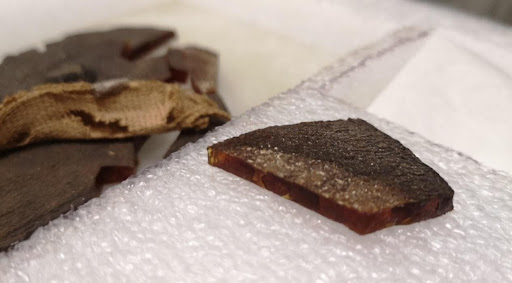
At first glance, the leather sandals and bags displayed at the Museo Egizio in Turin may seem like fragile relics of the past. Yet behind their worn surfaces lies a wealth of scientific information about how the ancient Egyptians tanned, dyed, and preserved animal hides thousands of years ago.
A collaboration between the Museo Egizio, the University of Rome Tor Vergata, The American University in Cairo, and the ISIS Neutron and Muon Source (UK), within the ISIS@MACH ITALIA framework, has revealed how these artefacts have changed at the molecular level over more than three millennia.
Using a combination of non-destructive analytical techniques, the team examined leather samples dating from around 1400 BCE to the Late Period. Traditional surface tools such as X-ray Fluorescence (XRF), Raman spectroscopy, and Scanning Electron Microscopy (SEM) were paired with Inelastic and Deep Inelastic Neutron Scattering (INS/DINS) performed on the TOSCA and VESUVIO spectrometers at ISIS.

While XRF and Raman analyses provided details about surface composition — including traces of potassium alum, iron oxides, phosphates, and carbonates linked to ancient tanning and curing methods — neutron scattering revealed what’s happening inside the material.
Neutron experiments showed that the ancient leathers still retain about 16% of their original water content, evidence of partial dehydration over time. This subtle loss of hydration weakens the collagen structure, leading to gelatinization — a process where the fibrous protein network breaks down, turning the leather soft and fragile.
Microscopy images revealed cracked and layered surfaces, along with crystalline residues of salts such as sodium chloride and calcium sulfate. These could be remnants of burial environments or past conservation treatments.
By combining all these methods, researchers gained a complete picture — from atomic to microscopic scales — of how the materials were produced and how they have aged. The study demonstrates how neutron-based techniques can complement standard laboratory analyses, providing deeper insight into hydration, composition, and preservation of organic cultural heritage materials.
“Neutron experiments give us a view inside the material, beyond what traditional techniques can show,” explains Professor Enrico Preziosi of the University of Rome Tor Vergata. “This approach helps us understand the long-term degradation of ancient artefacts and guides better strategies for their conservation.”
Through collaborations like this, ISIS@MACH ITALIA is helping bridge the gap between physics and heritage science — showing how powerful instruments can illuminate even the softest, most delicate materials of our shared history.
Further information:
Find the full research paper here: https://www.mdpi.com/2078-2489/13/10/467
ISIS@MACH: https://www.isis.stfc.ac.uk/Pages/A-new-partnership-between-ISIS-and-f.aspx