Science
Joanna Blaszczyk
28 February 2022

Testing the resilience of ultralow-power electronics for the Internet of Things

Researchers used the ChipIr neutron beam to study how ultra-low-power system-on-chips are affected by atmospheric neutron flux, providing valuable data for developing electronics with greater resistance to particle-induced errors.
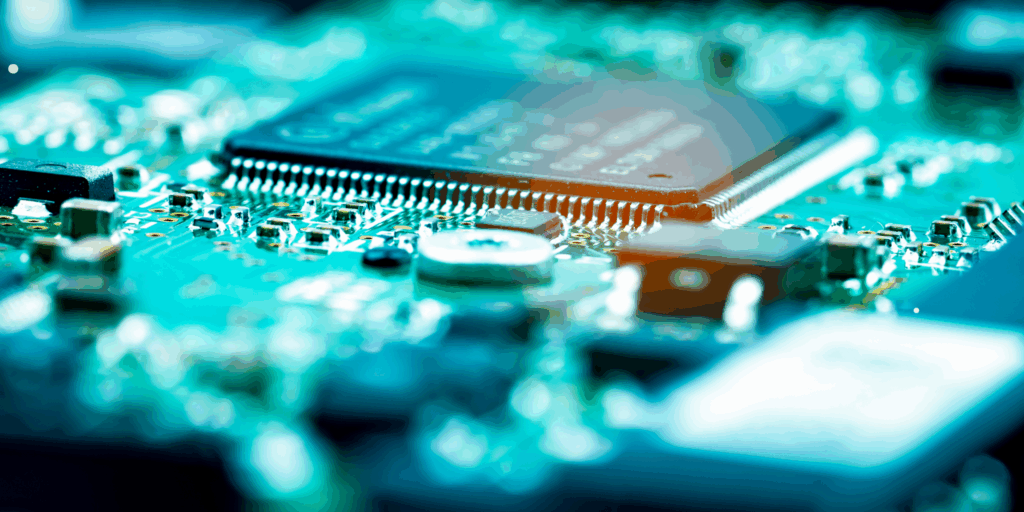

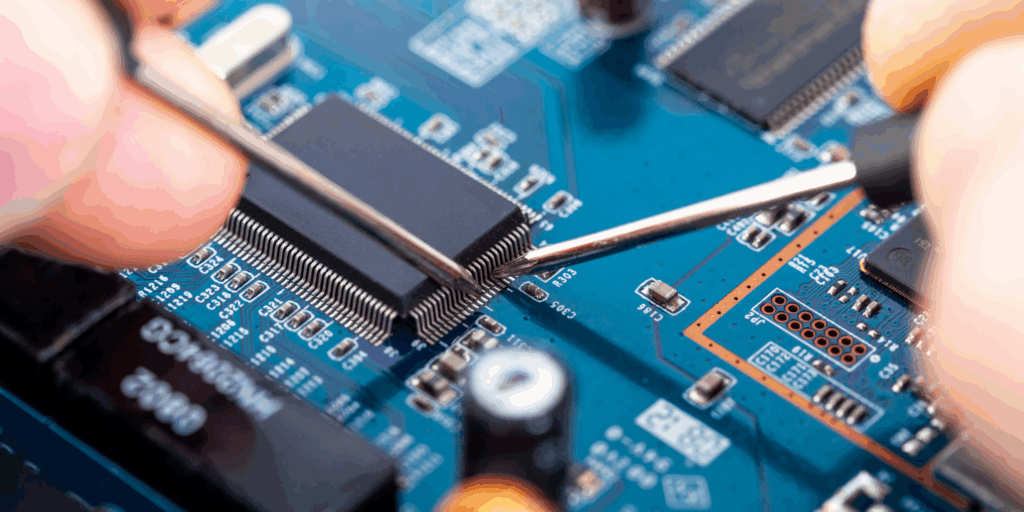
A system-on-chip integrates an entire electronic system—including hardware and software—onto a single circuit, improving energy efficiency and reliability while reducing size. These features make SoCs ideal for Internet of Things (IoT) applications, where small size and low power consumption are critical. The device tested in this study, the PLSense PLS10, is a prototype microcontroller designed for battery-operated IoT systems running at ultralow voltage.

Operating at lower voltage improves efficiency but increases vulnerability to single-event effects, in which energetic particles flip data bits from “1” to “0” or vice versa. Such effects can arise from alpha particles emitted by the chip itself or from neutrons generated by cosmic rays.

Using ChipIr’s controlled neutron beam—which reproduces the atmospheric neutron flux—and an alpha radiation source, the team evaluated the PLS10’s susceptibility to these effects. They observed that the device was more prone to “0 → 1” upsets than to “1 → 0” flips, particularly under neutron exposure, with larger differences for multiple-bit errors occurring within the same word. These multi-bit upsets are more complex to detect and correct than single errors and were linked to asymmetries in the logic cell structure.

For comparison, the same tests were carried out on a conventional higher-voltage chip, showing that the SoC’s sensitivity was similar despite its lower operating voltage. The use of ChipIr’s neutron flux—equivalent to atmospheric levels but 10⁹ times more intense—enabled accelerated testing, allowing radiation effects on modern low-power electronics to be studied efficiently.

This research, conducted within the Italian ISIS@MACH collaboration, was published as a feature article in IEEE Transactions on Nuclear Science.

Further information

The full paper can be found online at DOI: 10.1109/TNS.2021.3112622


"Using the ChipIr neutron beam at ISIS, researchers tested a new ultra-low-voltage system-on-chip for IoT applications, revealing how cosmic-ray-like neutrons can trigger data upsets and informing the design of more reliable low-power electronics."